
How to Read Odds at Kings Chip Casino
octobre 15, 2026
Understanding odds is one of the most useful skills for anyone exploring Kings Chip Casino. Odds describe the potential return from a wager, but they do not predict what will happen on the next spin, hand or match. They are a way to express probability and payout terms, and those terms vary between games. For players in the United Kingdom, it is worth learning how odds are displayed before depositing or placing a bet.
This guide explains common formats, how to compare a quoted price with its implied probability, and what to check in casino games. It also covers practical questions such as which app has Kings Chip Casino. Casino availability, licensing and payment options can change, so confirm current details directly with the operator and consult the relevant UK gambling guidance before playing.
What casino odds mean
Odds show the relationship between a stake and a possible return. In casino games, the rules and payout table usually provide this information. A roulette payout, for instance, tells you how much a winning selection returns relative to the stake. In sports betting, odds quote a price for an outcome. The price can be converted into an implied probability, although that figure includes the bookmaker’s margin and is not necessarily a neutral estimate.
Odds are not guarantees. A selection with a short price can lose, and a long-priced outcome can occur. In games based on random number generation, each eligible result is determined by the game’s rules and random process. Previous results do not make a particular outcome “due.” Reading odds helps you understand the terms of a bet; it does not remove uncertainty or create a reliable way to beat the game.
Common odds formats
Decimal odds
Decimal odds are widely used in the UK and are generally the easiest format to calculate. The quoted number includes the original stake in the total return. Multiply your stake by the decimal odds to find the gross return if the bet wins.
- Example: A £10 stake at odds of 3.00 returns £30 in total if successful.
- Profit: Subtract the original £10 stake, leaving £20 profit.
- Implied probability: Divide 1 by the decimal odds. At 3.00, this gives 0.333, or approximately 33.3% before considering margin.
At odds of 2.00, the gross return equals twice the stake, so a £10 winning bet returns £20, including the £10 stake. At 1.50, a £10 win returns £15 in total. These calculations describe the quoted payout, not the likelihood that the outcome will happen.
Fractional odds
Fractional odds, such as 5/1 or 7/2, are familiar to many UK bettors. The first number represents potential profit relative to the stake, while the second represents the stake required. At 5/1, a successful £2 bet earns £10 profit, plus the original £2 stake, for a £12 total return.
To convert fractional odds into decimal odds, divide the first number by the second and add one. For 5/1, that is 5 ÷ 1 + 1 = 6.00. The corresponding implied probability is 1 divided by 6, or about 16.7%, before any margin is considered.
American odds
Some international sports markets display American odds. A positive number, such as +200, indicates the profit from a £100 equivalent stake. A negative number, such as -150, indicates how much must be staked to make £100 profit. These prices can be converted into decimal odds, but UK players may find decimal or fractional displays more straightforward. Check the displayed format and currency before placing a wager.
Comparing odds and implied probability
Implied probability is a mathematical expression of a quoted price. For decimal odds, use:
Implied probability = 1 ÷ decimal odds × 100
For example, odds of 4.00 imply a probability of 25%. That does not mean the outcome has a proven one-in-four chance. It means that the price corresponds to that percentage before accounting for the operator’s margin and other market factors. In a market with several possible outcomes, adding the implied probabilities may produce a total above 100%. The excess is commonly called the overround and reflects the margin built into the prices.
Comparing prices only makes sense when the bets have identical conditions. Check whether a market includes overtime, how ties are settled, whether a game uses a specific rule variation, and whether the quoted return includes the stake. A number that looks larger is not automatically better if the underlying bet differs.
Reading odds in casino games
Table games
In roulette, the payout for each type of bet is displayed in the game rules or paytable. A straight-up number bet typically has a much larger listed payout than an even-money selection, but it also covers far fewer possible outcomes. The payout alone does not show the full picture: the wheel layout and rules affect the chance of a result and the game’s house edge. European, French and American roulette can differ, so check which version is open before betting.
Blackjack does not usually present odds as a fixed price for each hand. Instead, outcomes depend on the cards, the rules, and decisions such as whether to hit, stand or double. Look for the game’s rules, payout terms for a natural blackjack, and any restrictions on doubling or splitting. Two tables labelled “blackjack” can have meaningfully different rules.
Slots and other RNG games
Slot games commonly list a theoretical return to player (RTP), volatility information and a paytable. RTP is a long-run theoretical percentage across many plays, not a promise of what one player will receive in a session. A slot with a stated RTP of 96%, for example, does not guarantee that a £100 session will return £96. Short-term results can vary widely, and the paytable explains which symbols and combinations qualify for prizes.
Volatility describes the general pattern of payouts, not a prediction of when a win will arrive. A higher-volatility game may have less frequent but potentially larger prizes; a lower-volatility game may award smaller wins more often. Neither label makes a game more profitable for an individual player. Before starting, inspect the paytable, bet range, bonus-feature rules and any maximum win limits.
Practical checks before placing a bet
- Confirm whether the odds are decimal, fractional or another format.
- Check whether a quoted return includes your original stake.
- Read the game rules and paytable, including special conditions and limits.
- For sports markets, make sure the outcome and settlement rules match what you intend to bet on.
- Review the minimum and maximum stake, currency, and any fees or bonus conditions.
- Set a spending limit in advance and do not increase it to recover losses.
A calculator can help verify returns, but it cannot predict a random result. Keep a simple record of deposits and withdrawals if that helps you stay within your budget. If gambling stops feeling like entertainment or affects your finances or wellbeing, pause and seek support. In Great Britain, the National Gambling Helpline is available through GamCare; check its official site for current contact details and opening hours.
App access and account checks
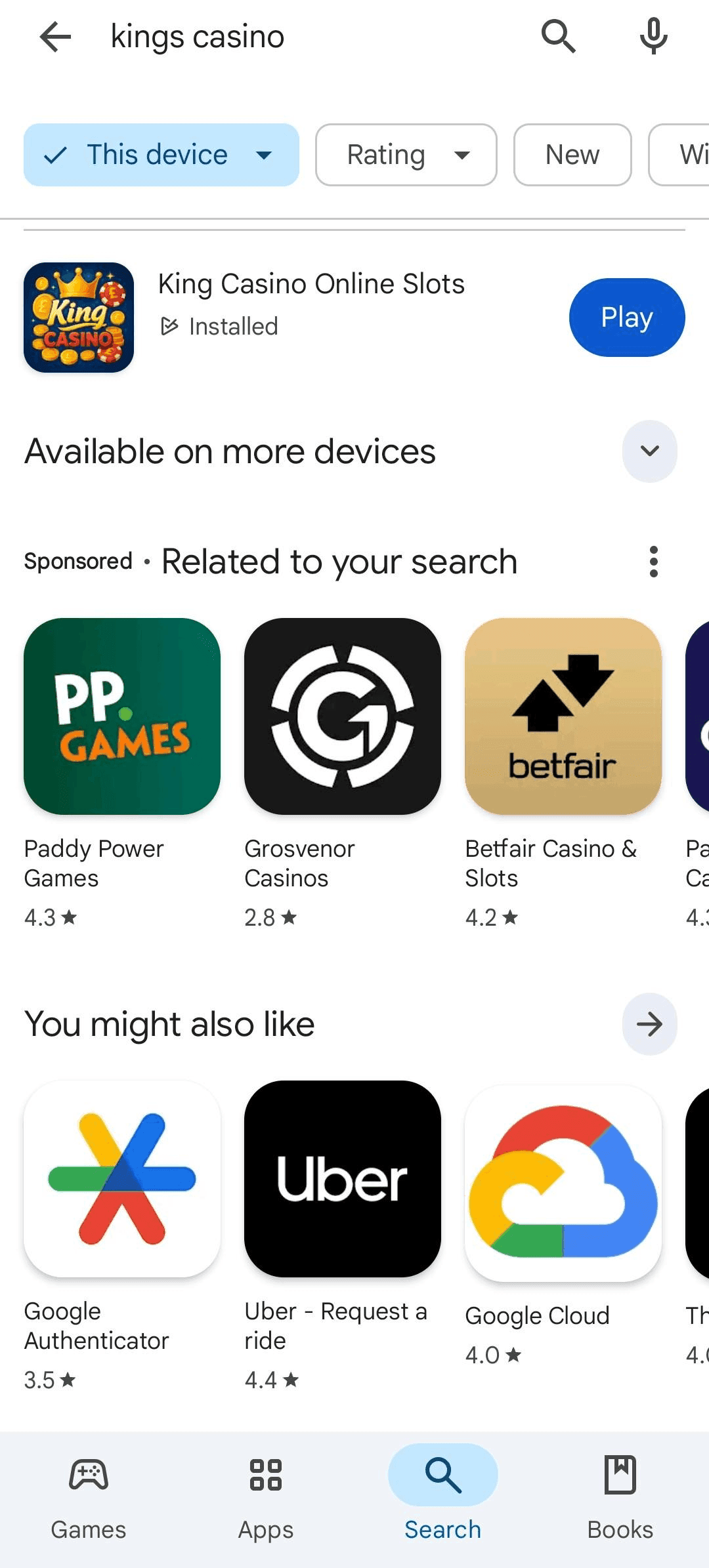
Players often search for a dedicated mobile app, but the existence, name and availability of an app can change. To find out which app has Kings Chip Casino, check the casino’s official website for its current mobile instructions and verify that any download link genuinely belongs to the operator. Avoid unofficial download sites, copied branding and links sent through unsolicited messages. If the casino offers a mobile website rather than a downloadable app, use the official address and look for secure account access.
Before creating an account, UK players should check whether the operator is authorised to provide gambling services in Great Britain. The UK Gambling Commission’s public register can be used to verify a licence and the licensed business name. Read the operator’s terms for identity checks, withdrawals, payment methods, promotional restrictions and account closure. Do not assume that a familiar logo or an app-store listing proves that a service is properly licensed.
Questions players ask about odds
Do higher odds mean a better chance of winning?
No. Higher odds usually mean a larger quoted return relative to the stake, but they commonly correspond to a lower implied probability. Compare the rules and the outcomes covered, rather than judging a bet by its payout alone.
Can I use odds to guarantee a casino win?
No. Odds explain prices and potential returns; they do not guarantee an outcome. Casino games carry risk, and strategies cannot eliminate the house edge or change the random result of a properly operated RNG game.
Is RTP the same as my chance of winning?
No. RTP is a theoretical long-term return measure, while the chance of winning a particular spin depends on the game’s mechanics and the definition of a “win.” A small prize may count as a win even when it is less than the stake. Read the paytable and game information for context.
Where can I check the current rules?
Use the game’s information panel and the casino’s official terms. For licensing in Great Britain, consult the UK Gambling Commission’s register and guidance. If a rule or payout is unclear, do not wager until you understand it.
Play with clear expectations
Odds are most useful when treated as information, not a forecast. Learn how the format works, calculate the gross return and profit separately, and compare only equivalent bets. For casino games, read the rules and paytable; for slots, treat RTP as a long-term theoretical figure rather than a session promise. Confirm that Kings Chip Casino’s access route and operating status are current through official sources, and keep gambling within limits you can afford. No odds format can make a risky bet certain or turn gambling into a dependable source of income.